
Visuals For Audio Book
The audio book could not provide the information set out in numerous tables. That information, along with supporting narrative, is provided here.
Table A – Investments that will last until your death
Percentage of income that must be invested to achieve a retirement in which continuing investment income plus gradual depletion of the savings will last a limit of 20 years. The boxed square indicates that a person who achieves an 11% investment return and works for 35 years will need to save 8% of their income to be able to continue their standard of living for 20 years after the start of their retirement. After that, they will have no money left.
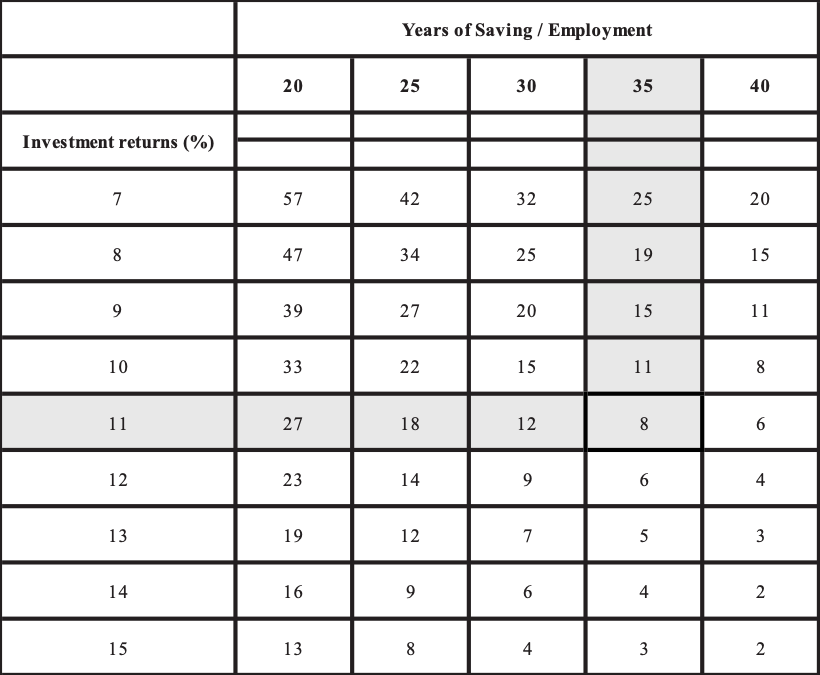
Table B – Investments that will last beyond your death
Percentage of income that must be invested to achieve retirement wealth in which ongoing investment income on the saved amount provides for ongoing annual payments and the saved amount is not depleted. The boxed square indicates that a person who can achieve an 11% return and works for 35 years will need to save 11% of their income to be able to continue their standard of living.
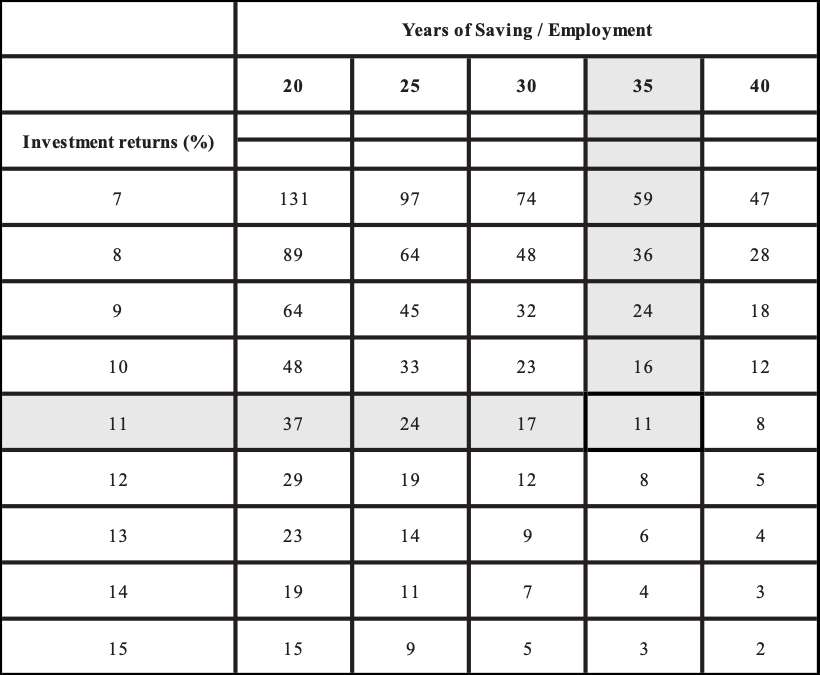
These two tables point out one of the most important principles of wealth management: You do not want to outlive your money!
56. Optimize your borrowings – Few people earn enough annual income to be able to purchase a car or a home by plunking down a wad of cash. They borrow, and borrowing costs can be substantial. Borrowing $200,000 for a 25-year mortgage to buy a home and paying back three $25,000 car loans during the same 25-year period costs about $225,000 in interest payments alone. Simply stated, the added cost of the interest on the loans can effectively double the purchase price of the goods.
Save as much as possible before making the purchase and reduce costs by borrowing the smallest amount necessary. Then, pay back the loan as quickly as possible. Even if you take out a long-term loan, make additional interim payments. Paying down loans early can save years of payments and typically one-quarter to one-half of your total interest expense.
The example below demonstrates the benefit of paying loans down quickly. Assume a loan of $1,000. The interest rate is 6.25% and repayment covers 25 years. Annual loan payments are $80. (Actual loans payments are made monthly but the math holds true in this example.)
The first year looks like this:
Table C
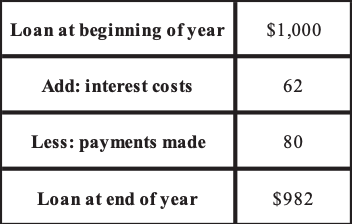
Of the $80 payment made, $62 went to pay the interest but only $18 went to reducing the amount of the loan. The effect becomes more apparent by reviewing additional years, as shown in the next table.
Table D
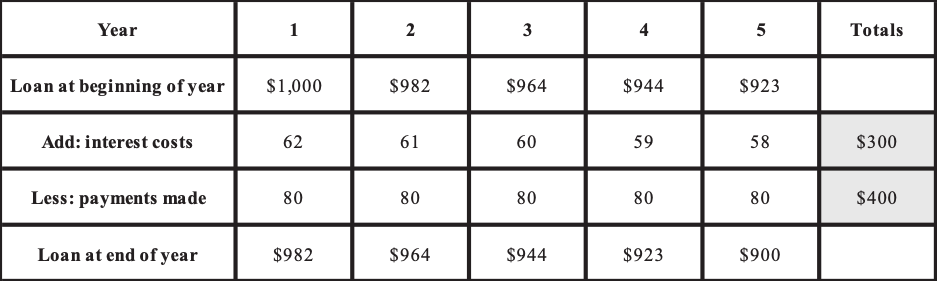
Here, after five years, and $400 in payments, the loan has reduced by only $100, to $900. A full $300 has gone to paying interest. The 25-year picture reveals more:
Table E
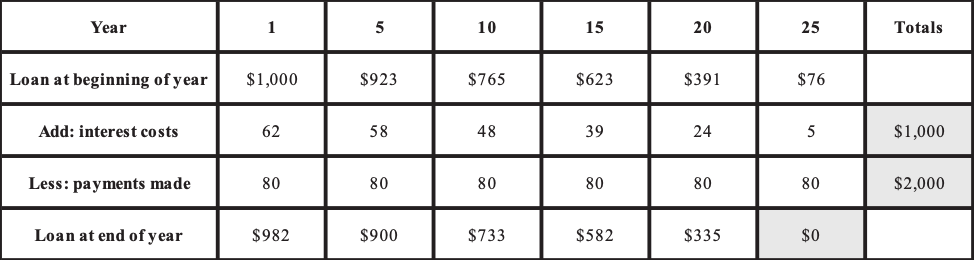
This table shows:
(i) It takes 25 years to pay back $1,000 at $80 per year
(ii) It takes $2,000 in total payments to buy a $1,000 item
(iii) The interest costs over the 25-year period amount to $1,000, the same total as the amount borrowed
This purchase will ultimately cost twice what you paid for it.
Table F uses the same math but for one small change – the loan payment has been increased from $80 per year to $105 per year.
Table F
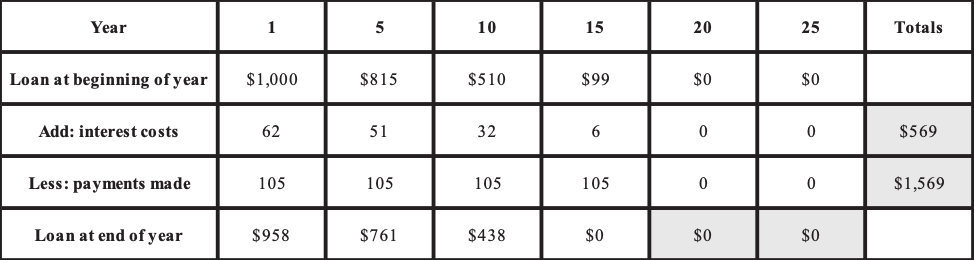
The difference is material. Total interest costs are now $569 versus $1,000 (before), total payments are now $1,569 versus $2,000 (before), and there are no payments for each of the 10 years past year 15. This gain is simply from increasing the payments.
Even if the payments cannot be increased from $80 to $105 at the start, the same beneficial effect occurs at any time the payments are increased. The magnitude of the benefit is simply changed. Here is the math when the payment is increased from $80 to $102 starting in the 10th year:
Table G
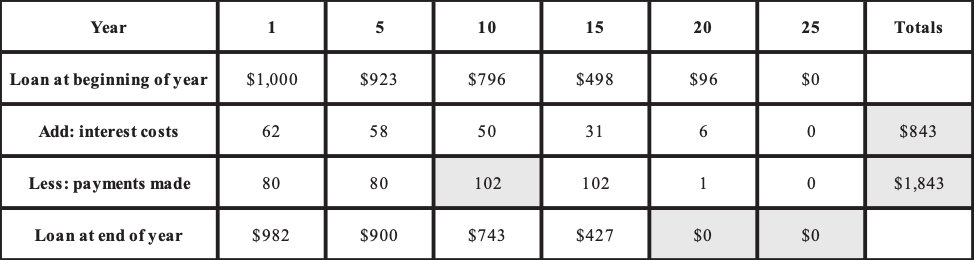
Now the interest-paid amount is $843 (still less than the original $1,000), the total paid is $1,843 (still less than the original $2,000), and the loan is paid out in 20 years, still avoiding any payments for the last five years. This is a great deal even when you start increased payments later in the plan.